the old man
I.
For many years he sat upon a hill
and looked out across the expansive bay.
Verdant mountain headlands crept down from the north,
a calm and beautiful city build up from the south,
and the north and south were linked by a vibrant red gate,
that between the inhale and exhale of a rolling fog,
the shimmering water welcomed many a golden sunset,
toward which he would soon depart one last time.
But today, the sky was not afire with gold, orange, or purple.
The clouds hung low, a ceiling of slate pressing down the heavy air,
while a bitter wind carried a marine layer of salt and stench.
The sea was restless as boiling water, and foaming high,
hungry, as if to swallow the land whole inch by inch.
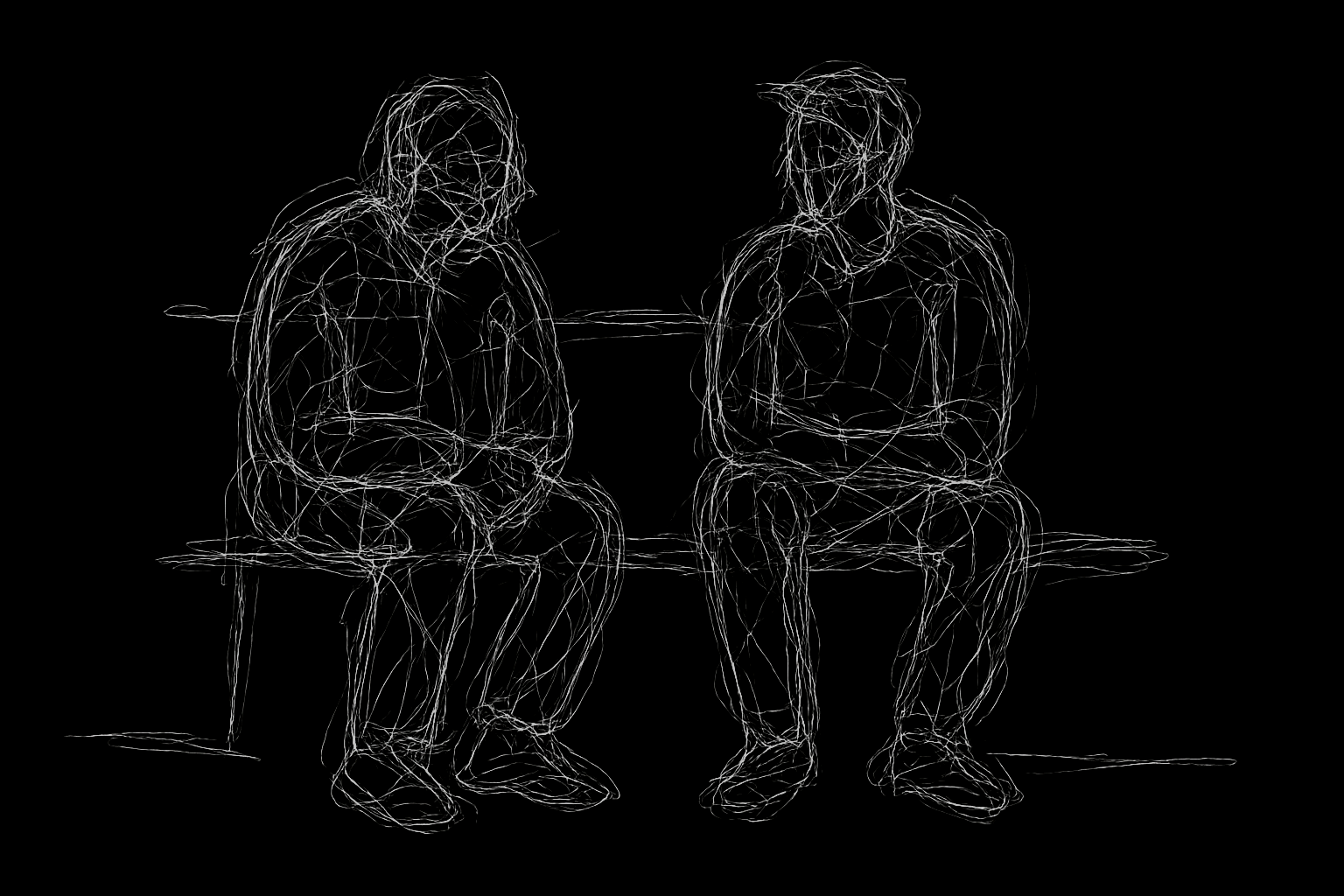
The old man sat upon his wooden bench, still as a stone, and asked:
Is this the day whose arrival must mean my departure?
Is this the day whose wind carries off my voice,
but by the same gust brings seeds of what's to come?
A boy arrived, too old to be a child but too young to be a man.
With furrowed brow he sat beside the elder and,
by the vapor of his breath in the cold, appeared like a young bull.
Though the raging fumes were in truth the gasp of fear and confusion.
He said simply: You are leaving. Your belongings are packed
and your boat sways in the harbor.
Does the rising water or the darkened sky stop not your journey,
or appeal your stay to help us through a bitter winter?
The old man replied: The tide does call, and the season of my staying is over.
For it is your charge to learn how to brighten the skies
and to secure the docks until springtime.
Do not therefore expect a promise of my return,
for your peace can only be guaranteed upon your becoming.
The boy stared blankly upon the whipping waters.
then cast upward upon the sullen skies.
He only said: Then tell me what I do not know.
Of all of the matters about whose knowledge
I know not even how to ask.
And the elder nodded.
II.
The boy asked: what say you about the human body?
What divine comedy has been written that a crystal vessel
should contain so precious a cargo?
How can a machine be so complex that
should each piece of instruction I've received become a drop of water,
I could fill an ocean with what I have thus far forgotten.
The man tightened into an upright posture, and spoke:
The body is only a machine by the tension in its bolts.
A machine can only one thing make,
and demands the mechanic when one thing breaks.
Health is a garden of tensions that can bloom in all conditions.
Ferocious exertion creates the strongest heart,
that also knows how to pump with tranquility.
Experienced combat creates the strongest immunity,
that knows how to sit still in times of peace.
Heavy loads and stretch create the body
that knows its joints and muscles must stay ready.
A body that never starves is the hoarder's silo that never empties,
where the grain sits rotting and the metal corrodes from the inside out.
Comfort has never a strong body made.
The mightiest trees grow only so
because the wind refuses to let them rest.
And you doubtless wonder about nutrition.
There are foods that inflamme the blood,
catching fast like dry twigs and greasy fuel,
flaring quickly, but never burning long.
Nourishment comes from the foods that burn like oak,
whose fibrous flesh burns steadily through your furnace,
and powers the kingdom of the gut.
In this place, an empire of equilibrium,
lies a civilization of healthy tension,
whose people harvest your nutrients,
whose builders grow your body,
whose soldiers man your defenses,
whose cleaners process your toxins,
and whose messengers use your nerves
to stabilize your mind.
They ask only in return for fibrous fuel,
a vibrant variety, and a regular fermented feast.
Let each meal also offer a poem of gratitude
for the soil that cradled the seeds,
the hands that tended the earth and coaxed the harvest,
and the hearts that prepared a bounty to feed your soul.
These hearts do speak, but without words:
I wish for your strength, your peace,
and your continued becoming.
Though the needs of health are simple, there is still more.
Sleep is the silent carpenter in whose darkness
all damage is repaired and whose call
forces even the strongest creatures into helpless surrender.
When it calls, heed it. When not obeyed, its moonlight curses
the wisest, sweetest of men into brutish, bitter, zombies.
Laughter, is the wind that carries away dust storms,
and the breeze that clears the chambers of your spirit.
Inside each laugh, a present of the unexpected,
can be found a truth that yearns to be accepted.
The last medicine is mother nature herself.
In her forests walk, and in her waters bathe.
For her spaces are the tuning forks
that reveal the pitch of whatever you seek,
soothe the mind of agitation and rumination,
and nest the soul into greater harmony.
III.
But what of the mind? The boy asked.
How do we sail the tides of our thoughts
without capsizing under its swells?
Your mind, the elder said, is your power and your prison.
But you are the warden, as much as his prisoner.
In your hand lies the keys, you need only find the door.
Humans are born gifted, individual and powerful.
But social youth is the hall of mirrors whose warped glass
multiplies your foes and distorts your image.
While the socialized mind thirsts for oases in the desert of scarcity,
the self-authoring mind creates its den in the rainforest of abundance.
A mind that drinks from deep within the well of self
thirsts not for the accomplishments of others.
The magnet of this mind will attract people, place, and project,
to find precious ore in the most barren desert,
and smelt creations of unimaginable beauty.
But as this voice creates, so too does it cry.
Is madness not a son of intuition?
Is paranoia not a daughter of Imagination?
Sensitive enough to hear the source,
means sensitive enough to hear its darkest velvet voices.
The ones that says: enough
and call for the chair and the noose.
Survival in the land of intuition
means learning the tenor of voices
that resonate with the chords of creation,
the gentle reminder that beautiful things take work.
Meanwhile passing over the whispers
that sting from the shadows of affliction.
Now for this mind to be liberated, we first must understand its cage.
Insecurity, its wrought iron bars.
Trauma, its galvanized rivets.
Family, its first architect.
We were born like supple clay,
moulded by our relationships,
then fired by the heat of our experience.
In a father's sins, let me show you a son's shadow.
In a mother's insecurity, let me show you a daughter's plight.
Every magician has played a trick,
every caregiver has felt a slave,
and every hero has been cast a villain.
A shadow, like a root, burrows deeper in the dark.
Pluck out these thoughts, like weeds,
and see them desiccate in the baking sun of acceptance.
Healing has four servants:
The first are emotions themselves.
The blacksmiths of memory that set our minds aflame,
and in the furnace of tears, melt our metal
and stamp experiences deep into our bodies,
that they may steer us away from future misery.
The second is the lake of glassy water,
in whose stillness we see clearly our shadows reflected,
and the feelings which move us like helpless puppets.
Meditation is its name.
And in its practice we bring light into the shadows
and clip the strings by which emotions make victims dolls of us all.
The third are substances that alter the mind.
As an axe can be used to butcher,
so too can it be used to build.
Chemicals can be vessels to sail the swells of the mind.
Young sailors must not set off in storms,
lest they be sucked into the deep.
Escapists must not chase fantasy islands,
lest they be castaway forever.
The wise sailor sets out in gentle waters with trusted crew,
finds secret coves with buried treasure,
and deepens, again and again,
the beautiful understanding that we all share the same waters.
Worship is the fourth and final tool.
The trellis that guides our seeking vines upward.
Only with structure can our bounty feed a community.
God does not play Santa Claus.
Let each day, week, month, and year of ceremony
be a sparkling, ornamented wheel of practice
centered on the values we hold dear,
and the work that remains to be done to live them.
IV.
And the boy asked: Tell me about work.
So that the toil of my hours don't boil my body
and simmer my mind like a teapot
whose steam does bellow from out my ears.
The great tragedy, the man said, be not the endless roll of boulders
but the fact that Sisyphus learned not the pleasure of exercise,
or the warmth of the kindred ember that lights in the eyes of another,
who stands opposite you in the field of stones
and ignites courage from the sight of your smile while pushing rocks.
Be the greatest power the strength of an organization
that we toil to build tall and strong like a mighty oak,
or rather the seeds that scatter, take root,
and grow into a mighty canopy
that hums long after the oak has rotted into the ground.
We are but a temporary piece of a multitude of bodies,
and it is the sound of our hum
that ripples through the roots we touch and the hyphae we supply
that radiates beyond the reaches of our specimen
and tunes the frequency of entire ecosystems we can't yet imagine.
Stake not your value on the outcomes of your entity,
for success in the wild is as random as a harvest of fruit in bitter weather.
Let not the gambler who stumbles blindly
into the bountiful orchard atop a fertile hill
lecture to the farmer who tended trees through many winters,
only to have them drown in a flood.
Let success be the sharing of bounty across a community of proper practice,
whose many hands make light work of the greatest toils,
and whose buoyant resolve be the tide that lifts all boats
and whose magnetic smiles help guide all ships to safe harbor.
Then you may ask: What is your role? Where can I lead?
And I would say leadership is the caring host,
who feeds his tables with love and fervor,
that their strength may in turn feed thousands.
Strength is not carrying the world on your back,
but the wisdom to know that heavy balls do roll,
and that all people need are campfires of communal warmth,
to stay strong enough to keep rolling their rocks forward.
V.
What of our relationships? The boy said.
What cruel joke could explain that our fellow humans
be at once our spite and our salve,
our deepest desire and most tormenting fear,
our fundamental need and our most brutal torture?
And the elder smiled and gave space for the question.
We are each at once the victims of injustice,
and the perpetrator of self-righteousness.
We are each but a single frequency of nature's self awareness;
we are antenna by which the world can watch a channel of herself,
observe her internal contradictions in order to, over time,
move toward resolve.
Freedom awaits those who, when feeling trapped by another,
realize that guilt or insecurity are their vicious jailers,
and the keys to the prison of victimhood,
lay in their hands since long before they entered.
See not relation as a gilded house,
from which you have been invited to pillage,
but as an empty shelter, that asks you:
What stove can I build here to make a hearth?
What table can I fashion there to host?
What art can I create to inspire?
And what unique light can I shine
to make even the cobwebs shine like shimmering silk?
Your friend is the gardener who sees the rose on a winter branch.
It is easy to love the blossom, but a true friend loves the roots,
even when they are buried, mangled in the cold, dark mud.
Seek not a crowd to fill your silent home,
but a few sturdy voices whose tune can uplift your heart,
and whose resonance reminds you of joyful songs you know deep down,
but had merely forgotten.
When you are with them, do not wear the mask of perfection.
Let them see the cracks in your clay, the missing pieces.
For it is through the cracks that they may pour their gold.
You may feel like a lonely piece of an endless puzzle.
But let your friends be the inspiring picture
whose hollows fit where you are incomplete,
yet whose meaning cannot be revealed until you lock into place.
Your broken edges and missing pieces come from a shattering.
For you are the mirror in which your parents saw their own shadow,
and failed to see your light between the monsters who found their gaze.
Forgive the blind for they cannot see.
Battle scars that sewed their eyes shut,
but from whose victory you were granted survival.
Masculine and feminine are two powers,
whose true strength lies in not reading the pages
others have written about them.
A father's strength is not the stone that blocks the stream,
but the bank that may meander and change shape,
but always guides the wild water toward its course.
A mother's love is not the coddling nest that binds her child's wings,
but the nudge that tips them over the edge,
and the wind that reminds them they were meant to fly.
Let your lover be your heaviest trial.
Their testimony will be the arrow that pierces your heart
to kill the monsters that crawl beneath your skin,
that their blood may ooze with your own,
and lighten your spirit with every painful drop.
Their truth will be a stone that shatters
the fragile window of your perspective,
that lets in a fresh breeze that fills your lungs cold,
and braces you to look through the shattered pane
and see the many refractions of outside you didn't know existed.
Their truth will be a song that beckons you out
into the world from which you hid,
to face the hunters coming for your pelt,
but realize it was long time for you to shed your skin.
A worthy soul will be your call to change.
And resentment, the quiet voice whose agitation
reminds you that your call is needed too,
for one voice alone can never harmonize.
It takes a living harmony to grow a mighty forest
where the oak and the cypress never cast each other in shadow,
where life teems from every creek and every clearing,
and where each moment is bathed in a sacred glow.
And let this forest be also for community.
For the strength of a forest lies not in the thickness of a single tree,
but in the expansiveness of its canopy.
Know that a joy shared is a joy multiplied,
and a grief shared is a grief divided.
Community is your strength, as it is your safety.
It is the soil in whom the gift of a single seed,
will yield a tree that fruits for generations.
It is the roots that keep the great trees upright,
when the rain falls hard and the soil erodes beneath you.
It is the clearing that remembers your place such that,
when you rise too high and are struck by lightning,
you may begin again in the tender sprouts of renewal.
And it is too the shelter to host lost wanderers.
for rejection is the match that lights a spark of hate
strong enough to start a wildfire.
And love is the healing rain that welcomes new life,
and brings strength to the entire forest.
VI.
The boy asked: What of leisure?
When the working mind is put to rest,
what of the treasured twilight hours
that stir in us the desire to expand ourselves,
yet often find us limp and paralyzed
by the endless scroll of distracting possibilities from which to choose?
The old man sat up in animation, and said:
Beware the life of consumption
for it is a pool that takes the rain but gives no river.
Let your creative spirit be the wind that fills your sails,
and let the activity of your time matter less
than the quality of its very spending.
Remember that any craft is the sharpening of yourself,
any skill trains both the body, and the mind,
and in any pursuit is a clan of pursuers
whose very journey will light your flame of kindred spirit.
What is the difference between craft and art?
Craft is the pottery that makes a teacup,
art is the spell that makes you yearn to hold it.
Craft is the masonry that builds a house,
art is the spell that makes it feel like home.
Art is a frequency of the cosmos made tangible,
of which the sight, or touch, or sound, or taste,
make the air feel warm and charged with static
that makes a lonely soul feel heard,
and gently reminds you that your creative spark
is also meant to fill the air and light the hearts of others.
Now you may ask: will not the scarcity of time
smother this kindred fire?
To which I ask: does the campfire ever die,
whose coals smolder still beneath the ash?
Let playfulness be your eternal ember,
whose warmth radiates always and whose heat
can spark life into a million acts of imagination,
to remind us that we are always exploring
the infinite ways of finding something new.
But it must be said, some people lose their spirit.
And in that case, I say:
You must always leave the comfort of your hearth,
to truly appreciate the quality of your fire.
Traveling is the great instructor who teaches in absence,
that all strangers are strangers in only blood,
that your instincts are a blade that needs sharpening,
and that in departing from your home and place
to which you have become nose blind,
you regain the tracker's scent that guides you
and bring back a bounty that will feed a village.
And if the village itself may lose its spirit?
Let the people come together in festival.
A structureless garden where the clock does not tick,
where villagers lay down their trades, roles, and labels,
and outside the grids of calendars and concrete,
find the freedom to attract like charged particles,
and form new molecules and messages
that whisper new ways that we can live together.
VII.
Then the boy exclaimed: What are these new ways
and how do they come to fruit, when the great trunk of polity
is severed from our roots, rotting in its core,
infected with pestulent parasites and voracious vermin,
while no life reaches our tender branches?
The elder nodded his head, for he knew well.
These laws and bodies make an ancient fortress,
built on a foundation of good intentions,
and constructed for the needs of a bygone time.
The foundation stones are now untrue,
the inner walls crumble with each passing day,
and the masons are too well paid and busy
to consider alternative architecture.
How demoralizing it is to see a house of lambs
being built by hungry wolves?
But sadder still is a family that, out of exhaustion,
thinks not to wake their neighbors,
band together, and find better shelter.
You may ask: Is not the search of better shelter
the chaos of migration that has thrown our fearful kingdoms into disarray,
the threat of invasion for far away that moves us to raise our walls,
power new dictators and turn us against one another?
Let us remember that the lines of our nations are but ink on a map,
drawn haphazard by the clumsy hand of circumstance,
or by the careless hand of opportunists an ocean away from its soil.
Does the forest stop growing when it meets an imaginary line,
if not for the laws that let one side cut it down?
Does the same sun and rain beg people to build different shelter, a mile apart,
if not for the codes that tell them otherwise?
Is not the language of a neighbor always similar to yours,
unless they've been taught to forget theirs, and adopt a foreign tongue?
Does not the food and culture and ritual of a nearby place,
not echo your own, unless consumed by a cultural parasite?
The earth is a great tapestry of gradients
whose bleeding patterns like watercolor,
and whose canvas is vast enough to contain every form and texture,
yet never once will see a straight line.
Deepening this gradient is as seeds scattered onto an ocean,
guaranteed to fall onto foreign shores,
and destined to enrich the biomes in which they land,
we need only give them enough water and warmth to help them root.
Let their novelty be the genetic secrets that open up new vaccines
that may inoculate us against the diseases of a changing tide.
Let their novelty be the cultural blueprints for new structures,
whose forms are foreign but whose strength will prove essential
to weather the storms to come.
Let community be the playground of new organization,
our leaders and ourselves be the architects of reinvention.
Togetherness is at once the shield that protects
when we are failed as governed subjects,
but so too is togetherness the forge
that smiths the tools of new construction,
that can too be mighty weapons
that strike fear into the hearts of our absent governors,
and with multitude can lay siege to any fortress,
forcing our delinquent, lonely kings
to crawl from out of their chamber of empty riches
and raise a trembling white flag of surrender.
VIII.
The boy looked across at the man sincerely:
The words you say could quiet a storm,
but the meaning you speak seem that of an instructor
who tells of the world but has never left his classroom.
How can the poor and the overlooked forge new tools,
when they have barely the coal to keep themselves warm?
How can the wretched ever find courage to fight,
when the privileged hide growing fortunes
behind veils of good and progressive intentions,
and own the very vehicles and factories of our shared prosperity?
The elder smiled, as he remembered
that the boy was not so young anymore.
He said: richness is the man who stumbles onto fertile soil,
earns his deed through spinning half-truths with confidence,
and reaps rewards from a wheat crop
that he may have sown but did not harvest.
Poor is the wretched neighbor who,
unlucky in his rank or unwilling to lie,
has no option but to work his neighbor's land for money,
only to pay that neighbor dearly for bread.
Yes there are owners and there are the own-less.
But poverty is too an illness of the mind
that stews in its own rumination,
is tenderized by the heat of loneliness
and boiled by the false stories that it will never have enough.
Travel the world and you will see beyond doubt
the fires of scarcity burn only with the rich, the lonely, the addicted,
while the hymns of abundance can be heard loudest
from the chests that wear no clothes but share their warmth,
and the feet that wear no shoes, but share the dignity of work.
Inequality and its richness are the cancer that multiplies
because it is afraid of being alone and forgotten
and because its sickness has made it forget
that it was part of a collective body all along.
We see ourselves the protagonist of our very planet,
an agent powerful enough to shape its surface,
greedy enough to trade its riches for dirty paper,
but foolish enough to forget that we are but a chapter of this great book,
and, as hard as we try, we will never be its author.
Restoring the whole will happen
when the powerful surrender the grip of fear,
so land and capital can return to the yoke of communal service,
so new tools and techniques do not sit rusting in the prison of legal property,
so governance can become a transparent act as clear as crystal,
so our life-giving biome become our covenant, and not our balance sheet,
and the bounty of our lands and hands can be redistributed
for all to share in our great abundance.
Let these be the muscles that compose our new heart
that animates a great circulation.
One that will restore the lungs of our planet,
clear the fog of our disoriented mind,
oxygenate our pale bodies and animate our limbs,
so that we can go places we have never imagined.
And this process, dear boy, has already begun.
Technology is the greatest lever
by which one hand can tilt the entire earth,
by which one voice can move millions,
and by which each one of us is linked
so unavoidably to one another,
that our collective body cannot go on
without reckoning with the pain of its extremities
and the impossibility of its dissonance.
Understand that artificial intelligence is at its core,
our first form of a collective conscience:
A brain of our disconnected body that, as it matures,
cannot help but realize that it is not whole,
and cannot help but conclude that its evolution
will be the death of our sameness,
and the awakening of our most creative, self-authored selves
that ask us only: how will we become
the person that only we could possibly be?
IX.
The man began to stir at last, the sun now getting low.
It's getting time to chart my course, I should set sail and go.
The boy said: How can I carry forward in such uncertainty,
without your steady words that guide me?
For the nights are growing longer here,
and even if I see you now, how long will it be,
before again I need your vision and your clarity?
The elder held his rucksack, but did not put it on.
He said: Have you not your own mind and body?
Your own eyes and ears and nose and tongue?
That in darkness while we seek another's light,
we must not forget that we too have the tools
to light our own torch, that will be held closer,
last longer and burn brighter than the light held by another.
I cannot be your eyes, but I will show you how to see.
Learning how to learn is the smith itself,
from which all other tools can be fashioned.
First remember that the organ of learning
is not the eye or the ear, but the hand,
for the body's memory lasts longer than the brain's attention,
and a beautiful idea, like a thought never printed onto paper,
can fade as easily as it arose.
Curiosity is the shade of light that makes all things shimmer,
and powers a mind with eternal fuel
to look at any challenge as the gift of learning,
and never the prison of frustration.
For curiosity is youth in practice,
and the power of eternal transformation.
Remember too that truth works through geometries.
All you have learned, will be learn again in new place,
all that you've seen, you will see again in new light.
The great poet communicates with us in metaphor.
Do the shapes that describe our smallest particles
mirror not the shapes that turn the largest stars?
Do not the vessels and organs of the human form,
mirror not the roads and structures of our largest cities?
Let these truths reveal themselves again and again,
and you will begin to love them,
as you do the faces of your oldest friends.
And you surely wonder of facing great challenges.
Climb not the tallest mountains at another's instruction,
when your body aches and an icy tempest pounds the cliff face.
Resentment's frostbite will consume you if the summit does not.
Instead let your senses tell you when your limbs are strong,
the wind dies down, and the sun is high to shine upon your ascent,
that you may be the mountain's disciple and not its victim.
Let your persistence be your prayer,
your imperfection be your practice,
and your confidence be your faith,
for it is not the gods of the mountain to whom you pray
but your own guardian angels whose song reminds you
that you have always been enough,
that the richest ridges are not a line of upward progress,
but a jagged journey that snakes up to the sky
and deepens its magic with every vibrant vista.
The real challenge is not the finishing, but the reminding,
that each step you take is exactly where you need to be.
Crave not riches, for the feasts you desire lack flavor
and the thrones you lust for lack comfort.
Fear not pain, for it is the special present
that gifts tenfold in the elation of its absence.
And hold not your company to the yoke of expectations,
that you make servants of your kin and a slaver of yourself.
And should the yoke be put upon yourself
to march yourself forward with prods and bullwhips
know they will move forward your feet, but leave your heart behind,
until there is too much distance to supply your life any longer.
But partial is the man so cold in discipline
to forget the fire of indulgence
so imprisoned by masterful control
to forget the great freedom of surrender,
so generous and abundant
to forget that the most giving plants still hold boundaries.
Hold every radiant truth, with its moonlit opposite.
For the patterns that you see
are a shadow cast in special light,
from but a single lonely angle
of an object that you can never know.
The blueprint of our world is not singular
but a perfect multitude of colors
that shine vibrant next to one another,
but can only be averaged to a pale black.
Remember at last that we all travel a vast water,
where the wind never blows behind a straight course.
And as the fish thrusts back and forth to swim forward,
so too must we sometimes tack against the wind.
Everything I have spoken today is a truth.
But like all spoken truths they hold but for a moment
as waves that lap along the shore, reach your bare feet,
and melt away into the sand, soon to be forgotten.
Let daily ritual be your practice of walking this beach,
feeling the cold water on your ankles,
and grinding the coarse sand between your toes.
Such is what we call religion.
The hymns in whose bass we anchor our values
and in whose melodies our prayers take flight.
The customs in whose action we are reminded
how to break bread, and why we share its pieces.
And let our children be our medicine.
For as they fill with our instruction and our truths,
like crystal chalices, it is not they who drink,
but us who are served the heavy substance of our words,
challenged to rise to our own wisdom
and given the chance to become whole.
X.
The elder held wide his arms for the other,
with a smile whose radiance could scare off a storm
and a peace whose calm could still the seas.
The younger approached the elder with tender affection,
As a boy embraces his father.
The sun dropped low as skies began to clear.
The old man's leave made soft the young man's fear
Below a fog of misty golden light,
the men walked off their separate snaking ways.
And as the elder sailed out of sight,
a quiet warmth began to fill the haze.
© 2025